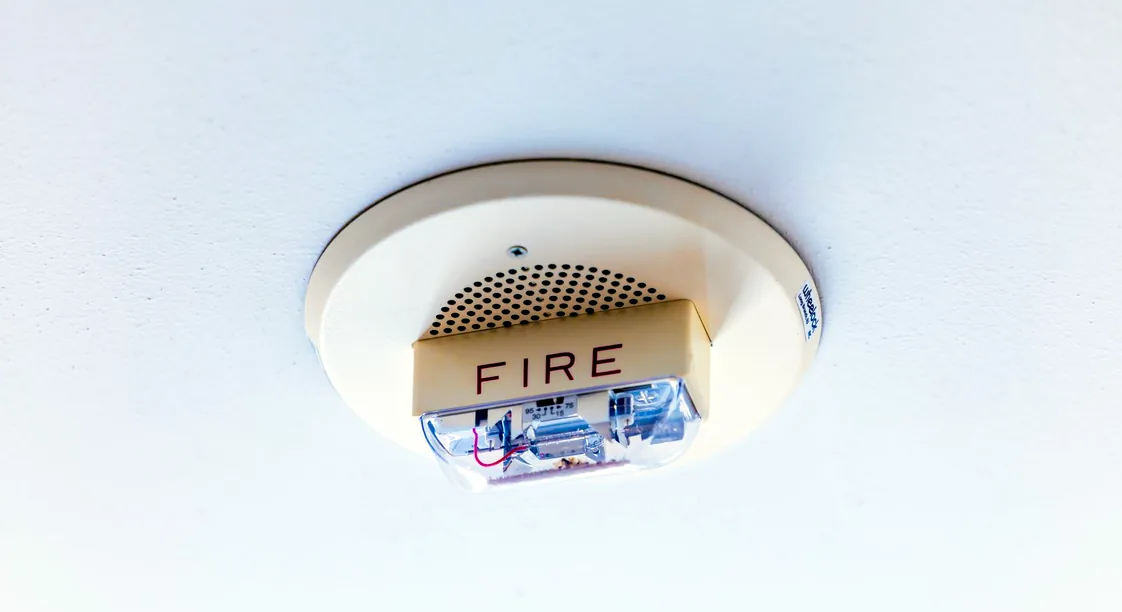
When a building has to be cleared, a ringing tone only says that something is wrong. A clear spoken instruction says what to do, where to go and which exits to avoid, and people act on it faster and with less panic. That is why voice evacuation has become the expected approach in larger and higher-risk buildings, and why it is treated as life-safety equipment rather than audio.
PA is not PAVA
An ordinary public address system for announcements or background music is engineered for convenience; a PAVA voice-alarm system is engineered to keep working when things fail. The difference is in the details that regulators care about: continuously monitored loudspeaker lines, standby batteries that ride through a mains failure, fault-tolerant wiring and supervised amplifiers with redundancy. A system that plays music perfectly may still not be lawful for evacuation, because it was never built to those rules.
The standards: EN 54, SBC 801 and Civil Defense
EN 54 is the European family of fire-detection and alarm standards, and several parts apply here: EN 54-16 for the voice-alarm control equipment, EN 54-24 for the loudspeakers and EN 54-4 for power supplies, alongside the detection devices under other parts. In the Kingdom this sits within Saudi Building Code SBC 801, the fire-protection requirements, and the system must gain Civil Defense approval before a building can be occupied. Designing to these from the outset, in step with Vision 2030 safety expectations, avoids costly rework at handover.
Speech you can actually understand
A voice message only works if people can make out the words over the alarm, the echo and their own stress. Intelligibility is measured objectively as STI, and reaching a passing score depends on loudspeaker spacing, room acoustics, reverberation and sensible zoning, not on sheer volume. It is verified by measurement at commissioning, so intelligibility is proven for the finished room rather than assumed from the design.
Working with fire detection
Voice evacuation is one half of a pair; fire detection is the other. A cause-and-effect plan links detected events to the right response: targeted messages to the affected zones, phased evacuation where a full clearance is not wanted at once, and a firefighters microphone that overrides automatic messages for live instructions. The two systems are commissioned and documented together so their behaviour is predictable on the day it matters.
Datacore designs PAVA and fire systems to EN 54 and SBC 801, carries them through Civil Defense approval and documents the intelligibility testing that proves them; speak to our systems team early in your project.
Frequently asked
What is the difference between PA and PAVA?
A PA system handles announcements and music. A PAVA voice-alarm system is life-safety rated, with monitored lines, battery backup and fault tolerance so it keeps working during an emergency.
Does a voice evacuation system need Civil Defense approval?
In Saudi Arabia, fire and evacuation systems must meet SBC 801 and gain Civil Defense approval before occupancy. Designing to EN 54 from the start supports that approval.
What is STI and why does it matter?
STI is a measure of speech intelligibility. A passing score confirms that evacuation messages can be understood in the real room, and it is checked by measurement during commissioning.